When you release the trigger on a pressure washer gun, water stops at the nozzle but the pump keeps spinning. All of that flow has to go somewhere. The unloader valve handles that job, diverting water back through the pump and into a bypass loop until you pull the trigger again. It is one of the simplest components on the pump, but one of the most common reasons a machine ends up on a repair bench.
Understanding how it works, and specifically what role the valve seat plays, makes the difference between a rebuild that lasts and one that fails again in three months.
How the Unloader Actually Works
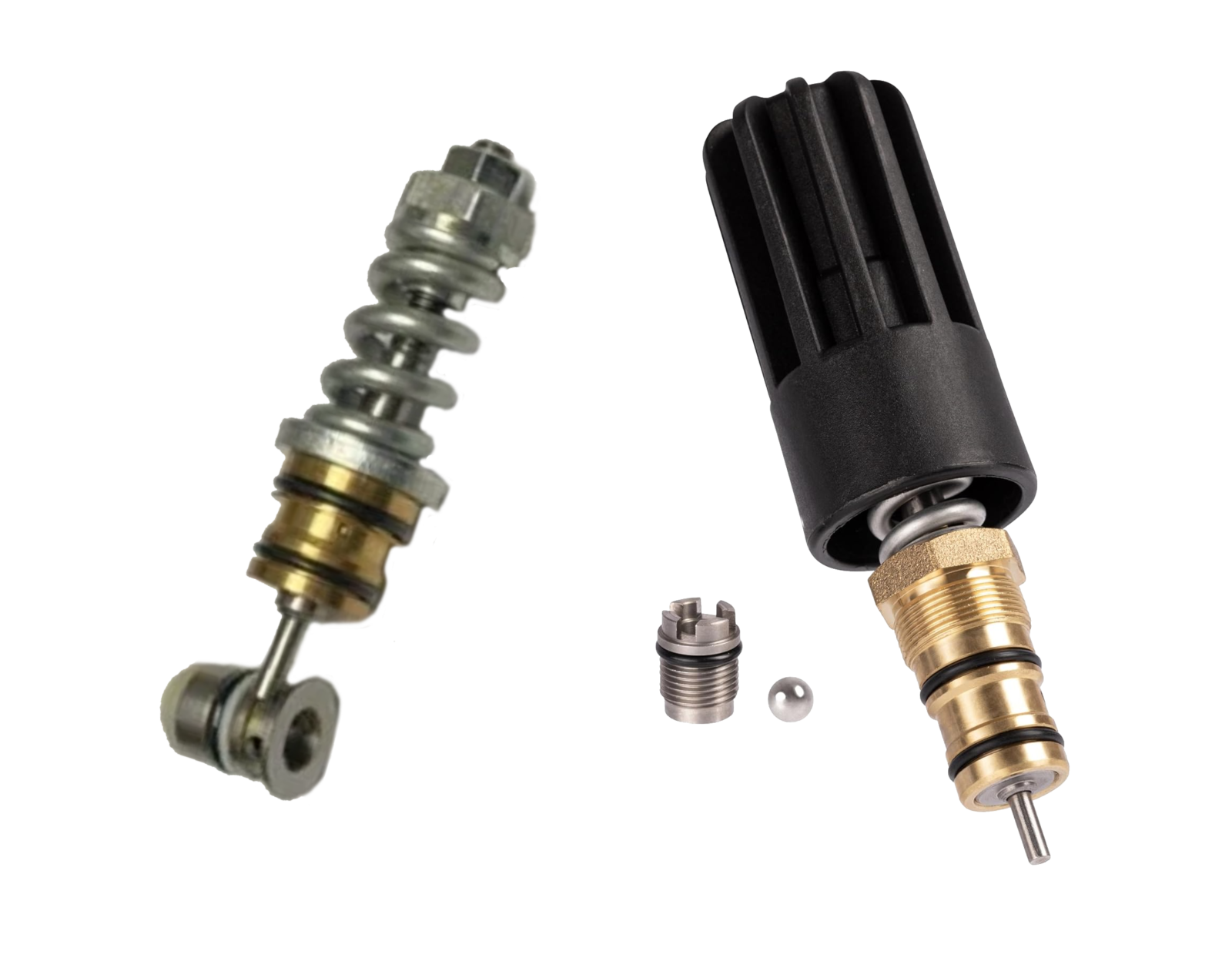
Around the valve body is typically a spring-loaded piston, and a ball sits against a precision-machined seat. During normal operation with the trigger pulled, water flows through freely at working pressure. The moment you release the trigger pressure spikes and creates tension on the spring, then the piston lifts off the seat allowing water to bypass back through the pump.
Two parts do all the work: the spring sets the threshold, and the seat creates the seal. A worn spring causes the valve to open too early and you lose working pressure. A damaged seat means water bypasses even when you want full pressure at the nozzle. Both are fixable, but the seat gets overlooked more often during a rebuild.
Threaded Seats
On professional grade triplex pumps and most mid-to-upper tier residential units, the valve seat is a separate component threaded into the unloader body. This detail matters more than it might seem.
A threaded seat is replaceable. You back it out, inspect the seating surface, swap it if it is scored or pitted, and reassemble with fresh O-rings. The O-ring on a threaded seat design sits in a groove on the seat itself or in the bore of the body. It prevents water from bypassing around the outside of the seat rather than through it, and it absorbs the micro-vibration that would otherwise wear the seat surface down over time.
The other advantage is consistency. Because the seat threads into a fixed depth, the geometry of the valve is always the same after a rebuild. That matters when the spring tension is calibrated to a specific seat height. Even a small variation in depth changes when the valve opens.
Many pumps are written off as needing a full replacement, in reality only needing a new seat and O-ring. The parts are cheap and the repair is straightforward if you know what you are dealing with.
Press Fit Seats
Press fit seats are driven into the unloader body using an interference fit, meaning the seat is slightly oversized and pressed in with force rather than threaded in. Like threaded designs, they still use O-rings to seal the valve. The difference is purely about serviceability.
You cannot easily remove a press fit seat without risking damage to the bore. If the seat is worn or scored, your options are limited. You can attempt extraction, but scoring the bore in the process is a real risk. You can try pressing it slightly deeper to re-establish contact, but that shifts the valve geometry. Most repair shops skip both and replace the entire unloader assembly, which is usually the cleaner call.
This design shows up on older pumps and lower-cost residential units. For light use applications it holds up fine. The design is cheaper to manufacture and, as long as the seat stays in good condition, it performs reliably. The limitation only becomes apparent when the seat needs to be replaced.
What Failure Looks Like
There are two signatures worth knowing:
- Pressure drop under load: The pressure drops when operating but returns when you release the trigger. That points to your unloader valve sticking, not allowing the seat to function properly. The pump is stuck in a constant bypass mode.
- High-pressure lock: This is when the pump sits down between uses with a fully pressurized head because the unloader did not fully open when the trigger was last released. On a gas unit the pull cord feels nearly locked. On an electric unit the motor sometimes will not turn over at all. This is usually a stuck or dirty unloader piston, but a seat that is not seating flush can contribute by holding the valve in a partially open position.
What to Look For During Inspection
Whether you have a threaded seat or are assessing a press fit before deciding whether to replace the assembly, you are looking for the same things.
Scoring is the most common finding—fine grooves cut into the seating surface from debris or from a piston that ran dry. Even light scoring breaks the hydraulic seal. Pitting from hard water or detergent exposure does the same thing. On a worn seat, the narrow contact ring between the piston and the seat surface widens and becomes uneven, which drops the sealing force unevenly around the perimeter.
On threaded designs, check the O-ring. A flattened or cracked O-ring is a guaranteed source of external bypass and almost always ships in a standard rebuild kit.
If your pump has a threaded seat unloader, a rebuild is almost always worth the attempt before replacing the unit. If it has a press fit seat and the seat itself is the problem, replacing the complete unloader assembly is the cleaner repair.